

Buying More Acres: A Farm Financing Checklist for Agricultural Borrowers
When the right tract comes up, speed matters. But in farm financing, speed usually has less to do with rushing and more to do with being ready.
That matters in a market where land can draw interest quickly. For borrowers, the practical takeaway is simple: If you want to compete for the right piece of ground, your lender conversations, financial snapshot, and core property questions should already be mostly in order before the listing hits.
That is the purpose of this checklist. It is not about pushing borrowers to move too fast. It is about helping them get organized early enough to make a sound decision when an opportunity appears.
Why Preparation Matters in Farm Financing
A land purchase often moves faster than the financing work behind it. Sellers want clean offers. Brokers want clarity. Lenders want a straightforward story they can underwrite. If one of those pieces is missing, a strong opportunity can become harder to win.
For agricultural loans, being prepared means two things:
- You need a usable property file: the parcel details, intended use, and key facts that affect value or income.
- You need a borrower file: the numbers and background that help a lender understand how the new acres fit your operation and how the debt will be repaid.
That matters because ag lenders usually size land loans around collateral, cash flow, and overall leverage, not just the purchase price. A borrower who can clearly show how the new tract supports the business is usually in a stronger position than one who is still trying to assemble that story after making an offer.
For some operators, conventional farm financing may be the right fit for an acquisition, refinance, or expansion. In other cases, FSA-backed options may make more sense, especially when equity is tighter or the borrower is still building scale. The key is understanding those paths early, not after time is already short.
Conventional Farm Financing vs. FSA-Backed Loans
| Conventional farm loan | FSA-backed loan |
|---|---|
| Best for: Established operators with stronger equity and cash flow | Best for: Beginning or underserved farmers, or borrowers with tighter equity |
| Down payment: Often 20%–35% | Down payment: As low as 5% cash in some Down Payment structures |
| Loan size: Often larger, based on lender policy and cash flow | Loan size: Program caps apply, depending on loan type |
| Speed: Usually faster with less paperwork | Speed: Often slower with more paperwork |
| Terms/rates: Market-based, with lender flexibility | Terms/rates: May offer lower-cost options, depending on program |
The Offer-Ready Property Checklist
Before you call a lender, assemble a one-page property snapshot. This helps your lender move faster, and it helps you test whether the deal makes sense.
Your snapshot should include:
- Location and legal description: Include parcel IDs, maps, total acres, legal description, and a basic acreage breakdown—tillable, pasture, timber, irrigated, and non-productive ground. If the tract includes multiple parcels, say that up front.
- Purchase terms: List the asking price, proposed offer price, earnest money, contract timing, and any unusual terms. A lender does not need every negotiation detail on day one, but they do need a clear starting point.
- Intended use: Be specific. Is this row-crop expansion, grazing ground, hay production, livestock support, permanent crop development, or a mix? If the land supports an existing operation, explain how. For example, “adds scale” is less useful than “adds 160 contiguous tillable acres that improve field efficiency and support crop rotation.”
- Existing leases and income: If someone else is farming the land today, document whether it is cash rent or crop share, how long the lease runs, and whether it transfers after closing. Lease terms can affect near-term income and when you can put the tract to your intended use.
- Improvements, water, and infrastructure: Note wells, pivots, irrigation systems, drainage, fencing, bins, barns, access roads, and utility service. These details can influence both value and repayment capacity because they affect productivity and future capital needs.
- Taxes and insurance. Pull recent property tax history and get a rough insurance estimate. Borrowers who understand these fixed costs early are less likely to build an acquisition plan on incomplete numbers.
What Lenders Are Really Asking About You
Most lenders still think in some version of the five C’s of credit: character, capacity, capital, collateral, and conditions. In plain English, they are asking five practical questions:
- Do you have a track record?
- Can the operation carry the payment?
- Are you bringing some equity?
- Is the land solid collateral?
- Does the deal make sense in the current market?
That framework is useful because it keeps the borrower story simple.
➝ Character is your management record and history of meeting obligations.
➝ Capacity is your ability to service debt from farm earnings, outside income, or both.
➝ Capital is your cash contribution and balance-sheet strength.
➝ Collateral is the value and quality of the land and improvements.
➝ Conditions include rates, commodity prices, the local land market, and the specifics of the property.
When borrowers get slowed down, it is often because these questions are being answered in pieces instead of one clear narrative. A lender should be able to understand what you are buying, why it fits the operation, what supports repayment, and how the purchase strengthens the business over time.
What You May Need to Bring to the Table
One of the most common questions in farm financing is simple: How much cash will I need?
For many conventional land structures, borrowers should expect that leverage will not cover the full purchase. In practical terms, many farm-focused lenders look for a down payment in the 20% to 30% range, and many cap loan-to-value at about 75% of appraised value.
A simple example:
A farm appraises at $1,000,000.
At 75% loan-to-value, the loan amount may be about $750,000.
That leaves about $250,000 in borrower equity or down payment.
Then look at the broader balance sheet. The purchase should not just work on the property itself. It should also leave the overall operation in a manageable leverage position. A borrower whose debt load remains reasonable after the purchase is generally in a stronger position than one who stretches too far to secure the tract.
The Borrower File That Speeds Up Underwriting
If you want to move faster when land becomes available, build the borrower file before you need it. A practical file usually includes:
- Recent balance sheet
- Income statement
- Current debt schedule
- Asset list
- Two to three years of tax returns, depending on the loan structure
- A 12-month cash-flow projection showing how the new land fits the plan
- Entity documents, if you are buying in an LLC or other borrowing entity
- Purchase contract or letter of intent once the property is identified
This is where preparation becomes a real advantage. Some conventional transactions require less documentation than others, while FSA-backed deals often call for more history and a more detailed business plan. A borrower who has the basics organized early can move more efficiently either way.
Speed Boosters That Can Run in Parallel
One of the best ways to shorten the path from accepted offer to closing is to stop treating the process like a straight line.
Several items can often move at the same time:
- Ownership and entity documents
- Lender review of your financial snapshot
- Appraisal discussions
- Title and insurance work
- Early collection of property-level supporting documents
Borrowers usually gain the most time by doing the basic organizational work early. Keep ownership documents current. Keep recent financials ready to share. Keep the property story simple enough that a lender does not have to pull core facts out over multiple conversations.
This is also where a good lender can add real value. The best financing conversations are not sales conversations. They are working sessions that help the borrower identify what matters most to underwriting, what documentation is worth gathering first, and what structure is most realistic for the transaction.
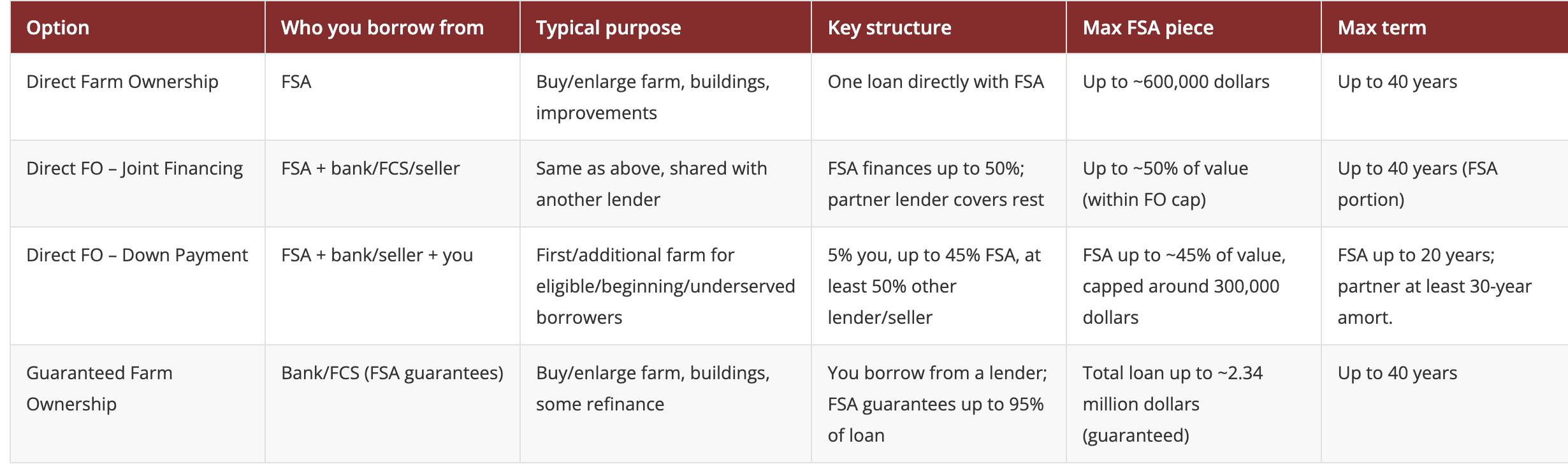
Know Your FSA Options
Not every borrower has a full 20% to 30% down payment ready, especially beginning farmers or operators still building equity.
That is where FSA ownership options can matter. Depending on the borrower and the deal, FSA programs may help cover a meaningful portion of the purchase and create a more workable path to ownership. In some structures, FSA can finance a substantial share of the transaction while another lender or the seller carries the balance.
FSA will not fit every acquisition. But it can be a practical backup plan when the conventional structure is tight on equity, collateral, or payment comfort. For borrowers looking at small farm loans or agriculture business loans, knowing those options early can make the process less restrictive.
FSA Farm Ownership Options
Make Sure the Purchase Still Fits the Operation
Before you move forward, take one more practical look at how the land purchase fits your broader operation.
How will the new payment work alongside your operating note, equipment debt, input costs, and seasonal cash needs? If the land is leased today, how does that affect timing and income in year one? If the tract needs drainage work, fencing, repairs, or other upgrades, where will those dollars come from?
This is also a good time to think about loan structure. Longer terms can help smooth annual payments, while fixed rates can add predictability. The right setup depends on the property, your cash flow cycle, and how the acquisition supports the business over time.
Just as important, avoid using every available dollar for the down payment. Keeping enough working capital on hand for inputs, repairs, livestock needs, and normal volatility is usually part of a healthier land purchase plan. Strong acquisitions should support the operation, not tighten it.
The goal is to make sure the purchase fits the business in a way that is sustainable and aligned with your longer-term plans.
The Bottom line
Buying more acres is rarely just a real estate decision. It is an operating decision, a balance-sheet decision, and a timing decision all at once.
The borrowers who move best are usually not the ones willing to gamble. They are the ones who already know their numbers, have a clean property file, and have a lender conversation far enough along that they can act with confidence when the right tract appears.
That is the real acquisition checklist: complete property information, a simple repayment story, organized borrower documents, realistic leverage, and a backup plan if the first structure does not fit.
If a deal looks promising but the structure is still unclear, a short conversation with a lender can be useful as a reality check before you spend time and money pursuing a tract that may not line up with your working capital or long-term plan.
If you’d like to talk, contact us at info@x-caliber.com.

Leave a Reply
Want to join the discussion?Feel free to contribute!